
Fertility basics
Tracking ovulation when your cycles are unpredictable
Which ovulation signs still help when cycle length jumps around, why LH strips can mislead with PCOS, and when a clinician's test is the better step.
Key takeaways
- With unpredictable cycles, a calendar can record what happened but cannot tell you when ovulation will happen. ASRM notes that in one study the best calendar app predicted the ovulation day only 21% of the time.
- A positive LH strip detects a hormone surge, not the release of an egg. Many people with PCOS have higher LH levels, so treat one positive as a clue and pair it with another sign.
- Cervical mucus can hint that fertile days are approaching, while a basal temperature rise only shows up afterwards. NICE advises against using temperature charts to confirm ovulation.
- If confirming ovulation matters, ask about a blood progesterone test. NICE says that with prolonged irregular cycles it may need to be taken later and repeated weekly until your next period.
You can still track ovulation when your cycles are unpredictable, but the goal changes. Instead of asking an app to forecast a date, you build a record of bleeding, cervical mucus, test results and temperature that shows what your body did. That record is useful. A prediction drawn from irregular dates is not, however confidently it is displayed.
This matters most with polycystic ovary syndrome (PCOS), which is now being renamed PMOS, but it is not the only reason cycles vary. Stress, thyroid conditions, breastfeeding, perimenopause, medicines and changes in eating or exercise can all move ovulation. Home tracking can describe a pattern and support a conversation with a clinician. It cannot confirm ovulation, diagnose PCOS, or work as contraception.
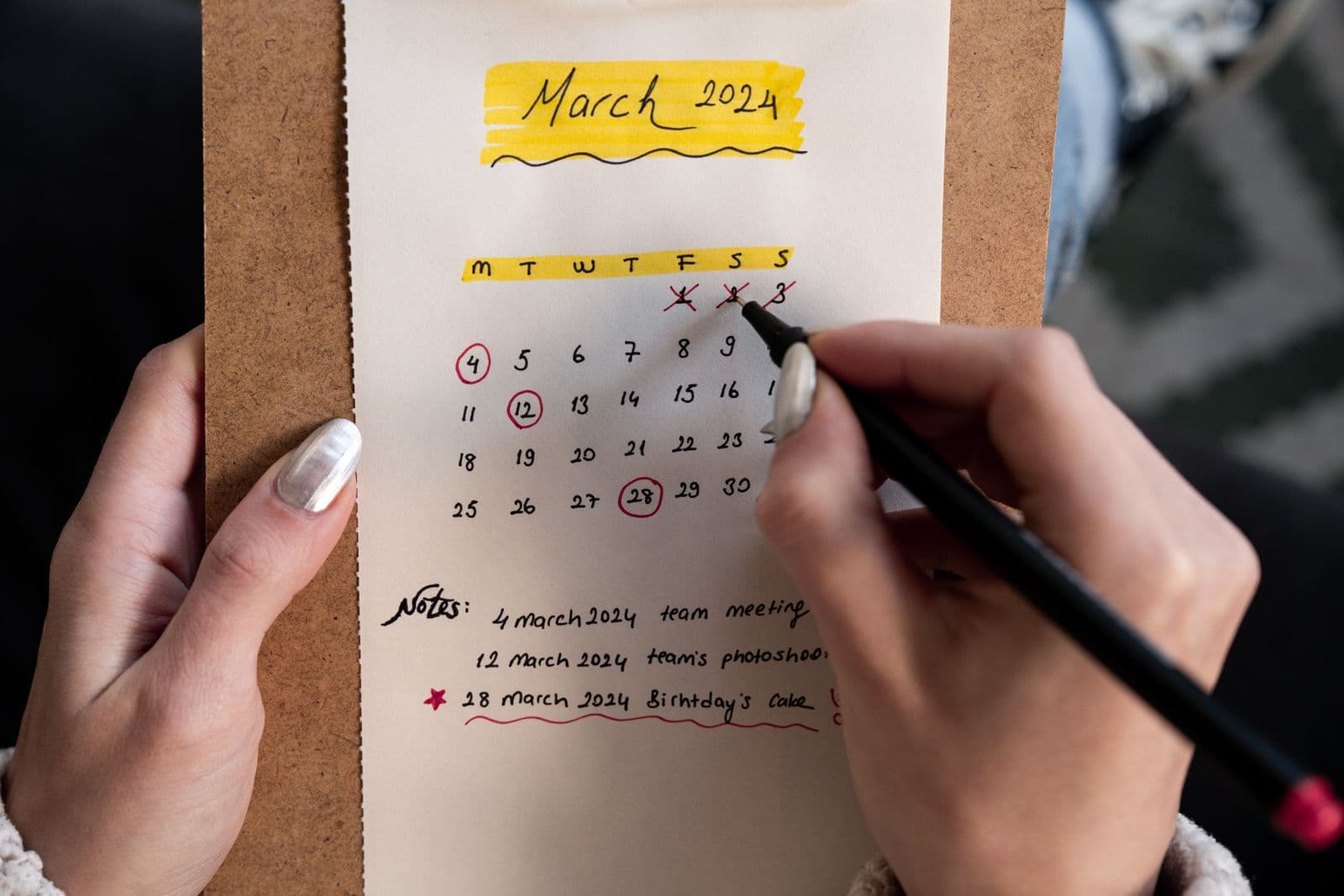
Why calendar predictions break down when cycles vary
A calendar estimate counts back from the period it expects next. In an average 28-day cycle, the American College of Obstetricians and Gynecologists (ACOG) says ovulation happens about 14 days before the next period starts. If you do not know when the next period will come, the count has nothing reliable to start from.
The American Society for Reproductive Medicine (ASRM) says the timing of the fertile window can vary considerably even in people with regular cycles. It cites a study of 949 volunteers in which calendar apps, checked against urine hormone tests, reached a maximum accuracy of 21% for the day of ovulation. ASRM puts the problem plainly: these tools assume a consistent fertile window when real cycles are much more variable. We cover the general case in why fertile-window predictions have limits.
| Method | What it can suggest | What it cannot tell you |
|---|---|---|
| Calendar estimate | A rough window based on past dates | Whether or when you will ovulate this cycle |
| LH strip | A hormone surge that often comes before ovulation | That an egg was released |
| Cervical mucus | Fertile days may be getting closer | A guaranteed fertile or safe day |
| Basal body temperature | A shift that may follow ovulation | The fertile window in advance |
| Blood progesterone | Whether ovulation is likely to have happened | The day it happened |
If you use Flowy, its fertile-window and ovulation markers are estimates calculated from the period dates and typical cycle length you enter. The app does not measure hormones, mucus or temperature, and it cannot confirm ovulation. With unpredictable cycles, treat the calendar view as a record of what happened rather than a forecast.
What a positive LH strip can and cannot show
Ovulation tests detect luteinising hormone (LH) in urine. In many cycles a surge of LH comes shortly before ovulation, and ASRM says ovulation may occur at any time within the two days after a detected surge. It also notes false-positive results in roughly 7% of cycles.
PCOS adds a further complication. A 2025 review in the Journal of Neuroendocrinology reports that more than 75% of people with PCOS who are not ovulating have raised LH levels in their blood. A higher background level can make a strip harder to interpret, and some people see repeated or long-running positives in a cycle without a clear end point.
A 2024 review in Seminars in Reproductive Medicine sets out the wider limits: you can ovulate without a detectable surge, ovulate before the surge is picked up, or detect a surge that does not lead to ovulation. It suggests pairing LH tests with a second sign, such as cervical mucus, to improve accuracy. The same review says the surge starts with the first positive test, not the darkest one. If you test:
- Follow the instructions: test at the time of day and frequency your kit recommends
- Log every result: include negatives, the time, and any missed days
- Note the first positive: that is the start of the surge, not the strongest line
- Set a limit: repeated positives are a reason to ask a clinician, not to keep buying strips
Cervical mucus gives an earlier, imperfect signal
As ovulation gets closer, rising oestrogen often makes cervical mucus wetter, clearer and more slippery. ASRM describes mucus monitoring as a way to identify when fertile days are approaching, and the NHS fertility awareness method records vaginal discharge alongside temperature and cycle dates every day.
Record what you notice in your own words, such as dry, sticky, creamy or slippery, rather than waiting for a textbook pattern. Lubricants, semen, infections and some medicines can change discharge. Cervical mucus and vaginal discharge explains the typical changes in more detail.
Discharge that itches, burns, smells strong or changes colour is a reason to get it checked, not a fertility sign.
Temperature looks backwards, not forwards
Basal body temperature (BBT) is your resting temperature on waking. After ovulation, progesterone tends to raise it slightly, so a sustained rise over several days may suggest ovulation has already happened. That timing is the main limit: by the time the rise appears, the most fertile days have passed.
Disrupted sleep, illness, alcohol, travel and shift work can all blur a chart, and long irregular cycles make the pattern harder to spot. The National Institute for Health and Care Excellence (NICE) says basal body temperature charts should not be used to confirm ovulation because they do not reliably predict it. If you chart anyway, our guide to basal body temperature tracking covers how to take readings consistently.
What "no confirmed ovulation" means
A cycle with no clear LH pattern or temperature shift does not prove you did not ovulate. A short surge may have fallen between tests, or a bad week of sleep may have flattened the chart. It is also possible that ovulation did not happen. Home signs alone cannot tell these apart.
The honest result of an unclear cycle is "not confirmed", not a guessed date. If you are trying to conceive, ASRM says sex every one to two days in the fertile window gives the highest pregnancy rates, and two to three times a week is nearly as effective. That rhythm avoids having to pinpoint one day. If you are avoiding pregnancy, use contraception rather than strips, charts or a period tracker.
When a clinician's test makes more sense
The 2023 International Evidence-based Guideline for PCOS says ovulation problems can occur even when cycles are regular, and that a blood progesterone test can be used if ovulation needs to be confirmed. NICE recommends a mid-luteal progesterone test for people being investigated for fertility problems. With prolonged irregular cycles, NICE says the test may need to be done later in the cycle and repeated weekly until the next period starts.
You do not need a perfect chart before you ask. Bring what you have:
- Bleeding: first and last day of each period, and any long gaps
- Cycle range: your shortest and longest recent cycles
- Test results: LH dates and times, including negatives
- Other signs: mucus notes, temperature readings, pain
- Context: medicines, contraception, breastfeeding, illness, chance of pregnancy
- Your goal: trying to conceive, avoiding pregnancy, or understanding a change
A PCOS diagnosis is not made from an app chart or a pile of positive strips. The international guideline uses two of three features once other causes are ruled out: irregular or absent ovulation, signs of higher androgens, and polycystic ovaries on an ultrasound or an alternative test.
When to seek care sooner
Book a routine appointment if your periods stop, keep arriving far apart, or are too unpredictable to plan around, or if you have new excess hair growth, severe acne or scalp hair thinning, or difficulty getting pregnant. These have several possible causes and are worth investigating properly.
Get urgent help for sudden severe pelvic pain, especially if you could be pregnant, or very heavy bleeding with dizziness or fainting. Do not assume severe pain is ovulation pain.
Frequently asked questions
Can I ovulate if my periods are irregular?
Yes. Irregular periods can mean ovulation is late, unpredictable or sometimes absent, but bleeding dates alone cannot tell you which. A clinician can arrange a progesterone test if you need to know.
Why do I keep getting positive LH tests with PCOS?
Many people with PCOS have higher LH levels, which can make strips harder to read, and a surge does not always lead to ovulation. Log the results and ask about a confirmation test rather than treating repeated positives as proof.
Is cervical mucus or temperature better for unpredictable cycles?
They answer different questions. Mucus may hint that fertile days are coming, while temperature can only suggest ovulation has passed, and NICE does not recommend temperature charts for confirming ovulation.
Can Flowy tell me when I ovulate?
No. Flowy estimates a fertile window from the cycle dates and typical length you enter. It does not measure hormones or temperature, confirm ovulation, diagnose PCOS, or provide contraception.
A record, not a verdict
An unclear chart is not a failed test. It is information: it shows that your cycle does not fit a calendar formula, and that is worth knowing. Keep the record simple, note what you are unsure about, and use it to decide with a clinician what to check next.
This article is general education, not a diagnosis or personal fertility advice. A period tracker is not contraception.
References
- American College of Obstetricians and Gynecologists: Fertility awareness-based methods of family planning
- American Society for Reproductive Medicine: Optimizing natural fertility, a committee opinion
- NHS: Natural family planning (fertility awareness)
- NICE: Fertility problems, assessment and treatment (NG257)
- 2023 International Evidence-based Guideline for the Assessment and Management of PCOS
- Current ovulation and luteal phase tracking methods and technologies, Seminars in Reproductive Medicine (2024)
- Neuroendocrine mechanisms responsible for elevated GnRH and LH pulses in polycystic ovary syndrome, Journal of Neuroendocrinology (2025)